How AP counts the vote
Discover
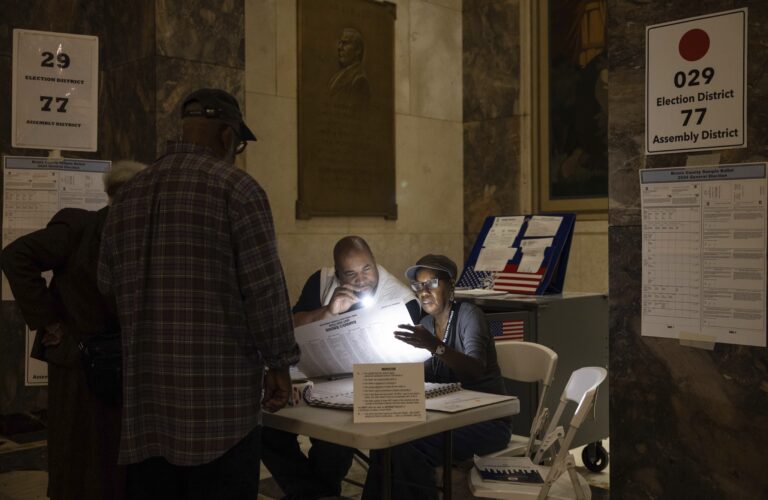
Elections are about voters and the choices they make. Every two years, Americans cast ballots to pick a new set of leaders in Washington, as well as in statehouses, county offices and city halls nationwide. Every voter has a reason for why they picked a candidate to represent their interests — or, perhaps, why they decided not to participate in an election at all.
The Voter Poll is a survey of the electorate, providing accurate insights into American voters and their opinions as soon as polls close. Launched in the 2025 November general election, The Voter Poll is election research that is accurate, trustworthy and free of partisan bias, providing details about voters that can’t be found from any other source.
AP has long been at the vanguard of the science of public opinion research, working with trusted partners to innovate how Election Day survey research is conducted and understood. We value the power survey research has to help us, our customers and our audience understand the motivations of voters and what drives them to cast a ballot.
In 2018, AP launched AP VoteCast in partnership with NORC at the University of Chicago. That survey was designed to address the challenges of a changing electorate, particularly the shift away from voting in person and toward casting ballots in advance.
Still, many voters do still vote at a neighborhood polling place. That’s why AP joined with ABC News, CBS News, CNN, Fox News, MSNOW and NBC News in 2025 to develop The Voter Poll, an evolution of AP VoteCast and traditional exit polling. Together, we hired SSRS Inc. – one of America’s foremost nonpartisan research organizations – to conduct the survey.
The Voter Poll uses a probability-based, state-by-state survey of registered voters verified to have cast a ballot that’s conducted by mail, phone and online. It’s design to capture their opinions regardless of how and when they cast their ballot. That data is blended with results from a probability-based sample of voters casting ballots in person, what we commonly call exit polls, as well as the results from a large non-probability sample of verified voters. This comprehensive approach that ensures our survey presents the most accurate picture of who has voted, and why.
When we conduct The Voter Poll, we ask voters nationwide to tell us what they think about issues such as healthcare, climate change, education and the economy. We also ask about the topics driving conversations in their state. Those questions generate answers that provides insight and in-depth understanding of what takes place on Election Day.
The Voter Poll is a survey of the American electorate aimed at telling the story of the results. It is designed to reveal the opinions held by American voters about candidates, the issues voters care about and their views on the future of the country. It helps power AP’s race calls on election night and ensures AP’s members and customers can tell the full story of elections in America.
It offers insight, starting at 5 p.m. ET on the day of an election, about voters verified to have cast a ballot and those Americans who have decide not to vote.
It is in part an exit poll, as it includes in-person interviews conducted at polling locations. It also includes mail, phone and online interviews in the days leading up to the election to meet voters where they are, including those who cast a ballot before Election Day by mail, absentee or via in-person early voting.
The Voter Poll is conducted by SSRS Inc. for The Associated Press and ABC News, CBS News, CNN, Fox News, MSNOW and NBC News. AP is the exclusive provider of results and data from The Voter Poll to all others, including media companies of all sizes and formats, as well as non-media users such as financial institutions, governments and nonprofit organizations.
Anyone who has a stake in the outcome of U.S. elections, wants to know more about the motivations of voters or seeks insight into the how and the why of Election Day can benefit from the data that makes up The Voter Poll.
The Voter Poll is built on the decades of experience in exit polling held by staff at SSRS Inc. and our media partners at the U.S. television networks, as well as the years of research at AP that went into the development of VoteCast. It captures the full nature of the American electorate: those who vote early or by mail, as well as those casting ballots in person on Election Day.
It returns results in every state holding an election for U.S. Senate or governor in a midterm election year, and in every state in a presidential election year.
The research and development that goes into The Voter Poll continues after every election. While the core methodology does not fundamentally change, SSRS, AP and other members of The Voter Poll consortium apply what we learn from the results of every election and update the methodology as needed to ensure the survey delivers the most accurate results possible.
Starting several days before Election Day and concluding as polls close, we interview tens of thousands of registered voters in English and Spanish. This part of The Voter Poll starts with a postcard, mailed to a random sample of registered voters in selected states, inviting them to take our survey either online or by phone.
We also call some of those registered voters directly by phone and surveys others using online survey panels, which allows SSRS to interview a very large number of people in just a few days. All of the voters who are interviewed during the pre-election survey are matched to the voter file, to ensure they actually cast a ballot. Then, on Election Day, SSRS also interviews thousands of voters immediately after they cast a ballot at their polling place.
SSRS then employs an innovative statistical calibration methodology to combine the results from the different interview methods. Finally, the results are combined with details from the actual vote count.
The Voter Poll includes a standard set of demographic questions, such as age, race and ethnicity, education level and income, as well as a series of opinion questions, seeking details on what issues voters care most about, their thoughts on the direction of the country and their opinions on a variety of topics that are specific to their state.
The questionnaire also asks for whom voters cast a ballot for president, U.S. Senate and governor, as well as the party of their candidate of choice for U.S. House.
AP will never call a race based on results of The Voter Poll alone. The survey serves as an additional data point among the many that our Decision Team uses to assess the state of an election.
In a small number of states with a longstanding history of dominance by a single party, and where other data – such as an overwhelming advantage in registration, advance ballot returns and pre-election polling – points to a victory by that party, results from The Voter Poll may be the final data point that allows AP to declare a winner as soon as polls are closed.

This page is not available in your selected language. You are now viewing the English version.